Roberto Schmidt/AFP/Getty Images
Important terms to know:
- State
- Bourgeois State
- Proletarian State
- Dictatorship of the Proletariat (DotP)
Common Misconceptions:
“The state is the same thing as the government”– The state is not the same as a government. The state exists because of class struggle. A government can exist without classes, such as administrative functions and planned economy.
“The state is the same thing as a nation” – The state is not the same as a nation. A nation has certain requirements, such as common land, language, economic life, and culture, while the state requires none of these in order to exist.
What is the role of the state?
The state is the instrument of oppression that upholds order in class society, both through force and political authority. To effectively resist it, we must understand its functions, purpose, and aims. The Marxist-Leninist view of the state can be summed up in three key points:
- It exists as a result of class struggle.
- It exists for the benefit of whatever class controls it.
- It has the monopoly on violence.
First, the state arises from class struggle. It is not unique to capitalism but exists in all class-based societies—whether slave, feudal, or capitalist—where there are oppressor and oppressed classes with fundamentally opposed interests. One class seeks to maintain its dominance; the other seeks to survive and eventually overthrow or replace the ruling class.
Under capitalism, this contradiction exists between the proletariat and the bourgeoisie, workers and owners. The bourgeoisie relies on the labor-power of the proletariat to generate capital, while the proletariat is forced to sell its labor to survive. Their interests are irreconcilable: no solution to the workers’ problems can come from the ruling class. Even under a so-called “perfect” welfare state, the bourgeoisie, driven by its class nature, will inevitably seek to increase profits by dismantling the welfare state wherever and whenever it can.
Second, the state emerged to serve the interests of the ruling, oppressive class. States existed long before capitalism; under feudalism, the state upheld the power of lords and landowners over serfs, slaves, peasants, and early proletarians. Just as feudal lords extracted wealth from the serfs, the bourgeoisie now maintains its dominance by exploiting the working class.
The proletariat does not submit to bourgeois rule voluntarily; it is compelled to do so by the coercive power of the state. This dynamic of enforcing class domination is not reproduced in a proletarian state, whose role differs fundamentally, as we’ll explore later.
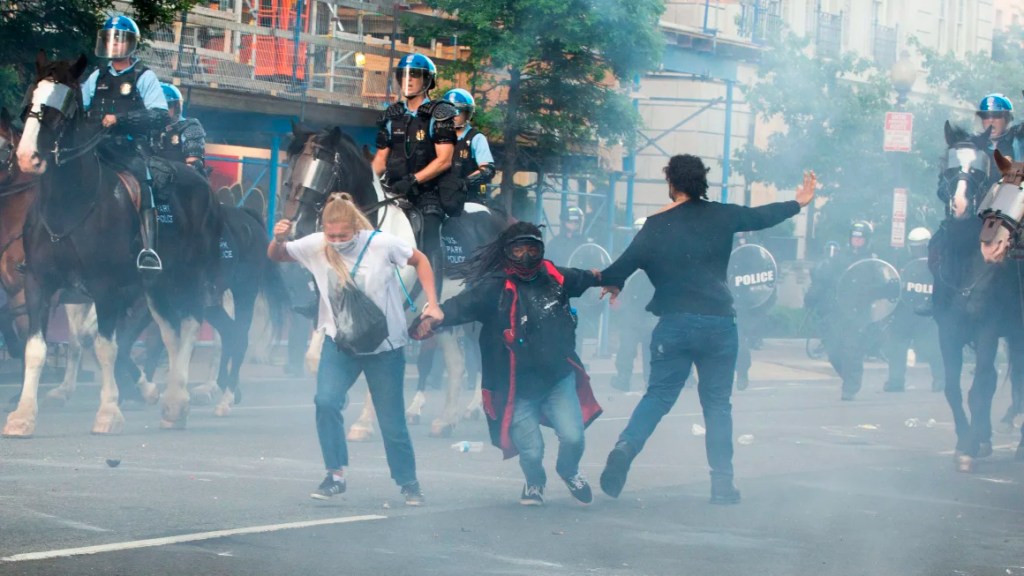
Third, the state holds a monopoly on violence. This violence is exercised through its police, military, courts, prisons, and other institutions. The ruling class does not simply announce its dominance and expect the oppressed to accept it. The state enforces that dominance by crafting laws and policies that disproportionately harm the working class, often backed by brute force.
In 2020, the Black Lives Matter and George Floyd protests were met with overwhelming police violence. Though these protests did not directly threaten bourgeois rule, they were still repressed, as any meaningful victory could have emboldened broader demands from the working class.
State violence is not always physical. The overturning of Roe v. Wade stripped millions of abortion access, resulting in preventable deaths, unwanted pregnancies, and economic hardship, an act of systemic cruelty with deep material consequences. Even fines, framed as “neutral” legal penalties, impact classes unequally: for the rich, they’re a minor inconvenience; for workers, they can mean missing rent or losing housing.
There is a plethora and ever evolving amount of methods for how the state enforces bourgeois rule. Violence, both direct and structural, is embedded in the state’s very foundation to preserve class domination.

The Proletarian State
When analyzing the state under capitalism, it’s useful to refer to it more precisely as the Bourgeois state—a state controlled by the bourgeoisie, the capitalist ruling class. This stands in contrast to the Proletarian state, or the Dictatorship of the Proletariat (DotP), in which the working class holds power.
The previous section focused on the bourgeois state. So what distinguishes the proletarian state from it?
The proletarian state is the inversion of the capitalist contradiction. Today, the bourgeoisie uses the state to dominate the proletariat. Under socialism, the proletariat seizes state power and uses it to suppress the bourgeoisie. However, unlike the bourgeois state, which exists to maintain class divisions—the proletarian state exists to abolish them. Its goal is to resolve the class contradiction entirely, paving the way for communism: a classless, moneyless, stateless society.
To do this, the working class must not merely take over the existing bourgeois state. That apparatus was designed by and for the bourgeoisie, cannot serve the revolutionary aims of socialism. A proletarian state cannot emerge from reforming bourgeois institutions, but must be built through revolution. The bourgeois state must be dismantled and replaced with one capable of advancing working-class interests and, ultimately, withering away.
As mentioned earlier, the proletarian state does not aim to preserve class struggle indefinitely, unlike the bourgeoisie, the feudal lords before them, or the slave owners before them. Instead, the proletarian state exists for two primary purposes:
- To defend the victory of a Proletarian revolution
- To end the contradiction of Bourgeoisie and Proletariat
First, to defend the victory of the proletariat. If the working class takes power but refuses to wield the state, it leaves the door wide open for the bourgeoisie to launch a counter-revolution. This threat is not hypothetical, it is a constant danger until the bourgeoisie as a class is fully dismantled. The proletarian state must suppress the remnants of the old ruling class, preventing them from regaining power.
The second function is to abolish the contradiction between the bourgeoisie and the proletariat. The proletarian state does not exist for the sake of domination, it exists to end class society altogether. While the exact process will differ based on material conditions, in general the proletarian state will expropriate the bourgeoisie, abolish private property, and reorganize production and society along socialist lines. This ushers in the transition from socialism to communism, often described as the withering away of the state. This is not instantaneous and will take generations to see results. Children will grow up in a society free from exploitation, with guaranteed access to housing, healthcare, education, and work. As society develops along these lines, state functions will gradually become obsolete. The values of greed and individual accumulation (products of capitalist ideology), will give way to cooperation, solidarity, and collective advancement. As the basis for class division erodes, so too will the state itself.
Revolution
It’s not enough to distinguish between the bourgeois and proletarian state, we must also confront the necessity of revolution. The bourgeois state will not simply collapse on its own, it must be overthrown. The proletarian revolution will not emerge spontaneously, but will be the result of deliberate, organized struggle aimed at smashing the existing state apparatus.
The path to revolution is built through countless actions: organizing reading groups, forming unions, fighting for temporary concessions, joining Communist Parties, engaging in strikes, and developing forms of Dual Power. These efforts are essential and must be supported, but none of them, in isolation or even combined, are enough to end capitalism.
Only the working class, under the leadership of a revolutionary vanguard (a disciplined, professional Marxist-Leninist Party) can carry out the revolution, dismantle the bourgeois state, and begin constructing socialism.
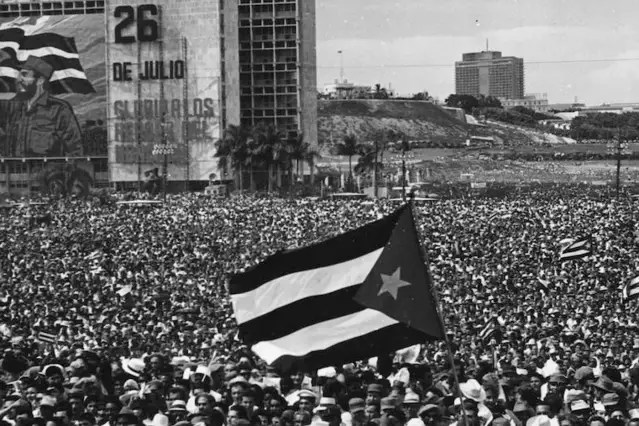
The proletariat does not inherit the bourgeois state; it destroys it. That may seem counter-intuitive, why tear down a state that already exists? Because this state, in every part of its machinery, laws, courts, prisons, military and police was built to serve the bourgeoisie. It cannot be repurposed to serve the proletariat. Its very function is to preserve class rule and suppress the working class. To attempt to wield it would be to compromise the goals of socialism from the start.
But the proletarian state does not appear out of thin air after the revolution. Its foundations are laid in the course of struggle. Dual Power plays a crucial role, building institutions and structures that meet the needs of the working class in defiance of bourgeois authority. These may include mutual aid networks, community defense, labor councils, and more. Each step undermines bourgeois legitimacy and prepares the working class to govern in its own name.
Every ruling class has its own revolution associated with it. Just like the bourgeois revolution overthrew the aristocracy of old, the proletarian revolution will overthrow the bourgeoisie
The term “dictatorship” can be alarming to many, understandably so. But what’s often missed is that the proletariat already lives under a dictatorship every single day: the dictatorship of the bourgeoisie. This reality is obscured by generations of propaganda that invert the truth. The blame doesn’t fall on the working class for their confusion; they’ve been told their whole lives by schools, media, and politicians that they live in a democracy. In reality, it’s a democracy for the rich. Imperialist powers constantly cloak their actions in the language of “freedom” and “human rights,” justifying war, sanctions, and exploitation under the guise of defending democracy. But what they’re defending is the global dictatorship of capital.
How does the state oppress the working class?
The bourgeois state wields immense power through its control of media, laws, police, prisons, education, and other institutions, allowing it to shape narratives that serve its interests. It spreads the myth that class dictatorship does not exist, that everyone has equal opportunities through hard work, and that wealth inequality is simply natural. These are lies designed to obscure the reality of class struggle. One of the bourgeoisie’s key tactics is dividing the working class, turning workers against each other to prevent them from uniting against their true oppressors.
Before developing class consciousness, the proletariat often fails to recognize itself as a unified class. Instead, workers see divisions identifying as middle, upper-middle, and lower-middle class or hold reactionary beliefs, including racism and xenophobia. While the bourgeoisie did not create these divisions, they exploit them to maintain control. Through education and media, the state reinforces these prejudices, using issues like immigration to stoke fear and nationalism. Immigrants are scapegoated as “job stealers” or “burdens on society,” while the real enemy, the capitalist class that exploits all workers, goes unchallenged.
The most oppressed sections of the working class, those facing state violence, racism, and systemic discrimination, hold immense revolutionary potential. They have suffered the most under capitalism and stand to gain the most from its overthrow. A successful proletarian revolution cannot exclude these workers; it must be led by the entire working class in all its diversity. As class consciousness grows, the contradictions between workers and capitalists will sharpen. The bourgeoisie’s greatest fear is a united, revolutionary proletariat, and they will do everything in their power to prevent it. The only force that can end their dictatorship is the organized working class, fighting not as divided individuals but as one revolutionary force.
It is for these reasons, and many more, that the CLAW Party rejects social chauvinistic organizations such as the ACP (American “Communist” Party), and all other “Patriotic Socialists,” just as we reject all forms of reactionary ideology.
For Further Information on the State:
- On Authority
-Friedrich Engels - The Origin of the Family, Private Property and the State
-Friedrich Engels - State and Revolution
-Vladimir Lenin - Anarchism or Socialism
-Josef Stalin
 Committee of Labor for Arkansas Workers Party